The Annapurna Trail route passing through Poon Hill into the Annapurna Base Camp trek is the one that, after that initial "WOW," you can have experience with, and it continues for the whole week of the trek. The ABC route combines two of the best trekking areas of Nepal into one single walk.
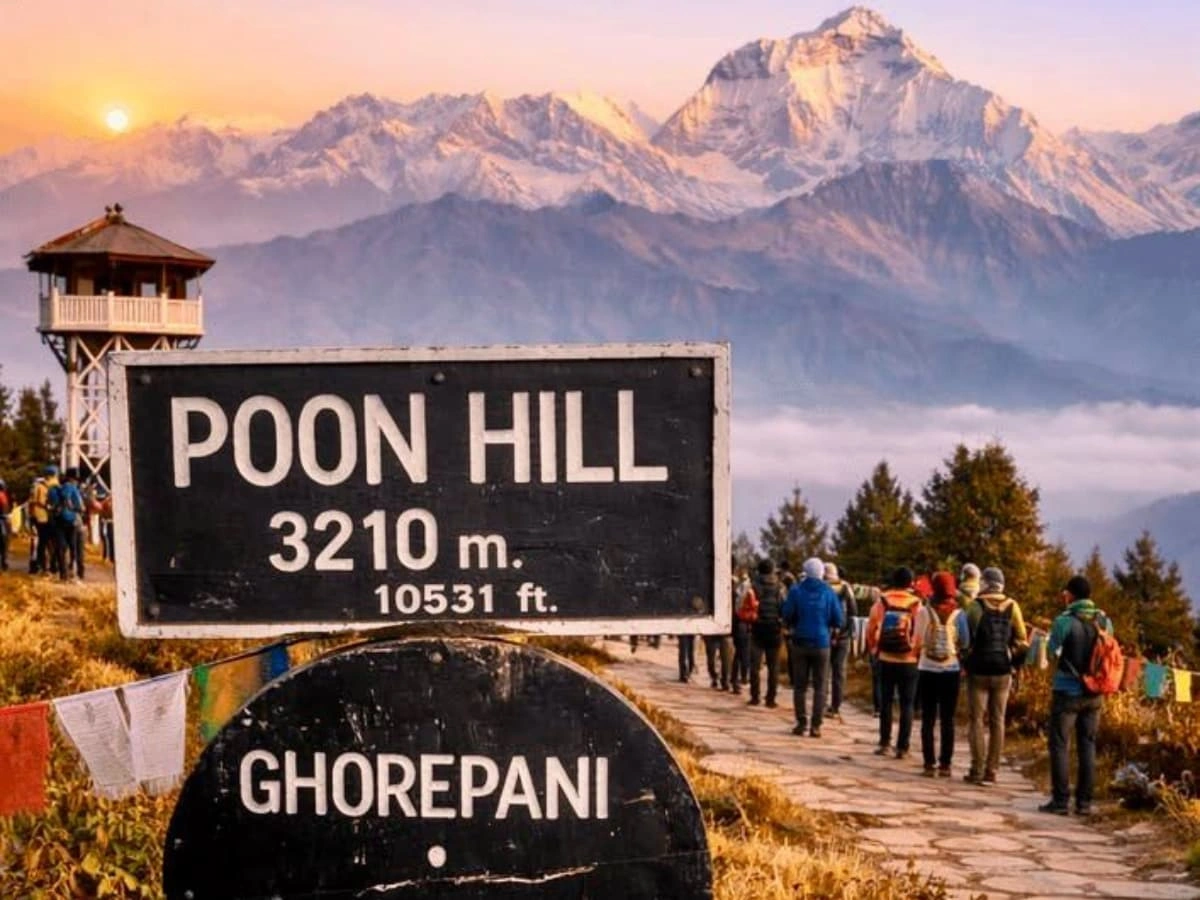
Firstly, it's Poon Hill, from where you will see the sunrise over Dhaulagiri and the Annapurna range; then it's the far more spectacular Annapurna Sanctuary (reached at Annapurna Base Camp (4130 m)). The idea of completing the other options before undertaking the trek, which most trekkers do, makes sense' It is a longer route than the direct ABC route, but the additional time walking through Ghorepani or discovering the rhododendron forests around Tadapani would make the entire experience much more enjoyable than the direct one to the ABC.
It is very perceptible. The route from Pokhara to Annapurna Base Camp by this trail passes through the villages of Gurung and Magar, which have been the hosts to the trekkers for many decades. It takes to go through some of the thickest rhododendron forests of the Himalaya and finally reaches the high-altitude sanctuary, which is encircled by the world's giant mountains.
There are 4 spectacular peaks surrounding the Annapurna Base Camp (ABC). In order, there is Annapurna I (8,091 m), Machhapuchhre (6,993 m), Hiunchuli, and Annapurna South to make an almost complete circle. It is such a breathtaking sight, and I find it hard to describe in words. Searching for an Annapurna Base Camp Trek Guide, including the Poon Hill extension? Well, this is the report you are looking for. We have every bit of detail you might require about the permits, what to pack and do, weather patterns, cost, etc.
Annapurna Base Camp Trek via Poon Hill Overview
The Annapurna Base Camp trek via Poon Hill runs for 10 to 11 days, depending on your pace and acclimatisation needs. Most organized groups complete it in 10 days of trekking after arriving in Nepal.
The trek starts with a drive from Pokhara to Nayapul, then climbs steeply through Ulleri toward Ghorepani. From Ghorepani, an early morning side trip takes you up to Poon Hill viewpoint at 3,210 meters before you continue east through Tadapani toward Chhomrong, the gateway to the Annapurna Sanctuary. The trail then follows the Modi Khola River Valley through bamboo and rhododendron forest all the way to Annapurna Base Camp.
This is a moderate to moderately hard trek. Daily walking averages 5-7 hours. The maximum altitude is 4,130 meters at Annapurna Base Camp. No technical climbing is involved, but you do need good physical fitness and some mental preparation for the long stone staircase at Ulleri.
What separates this route from the standard, more direct route to the Jhinu Danda hot springs, following the Modi Khola river valley, is the westward loop through Ghorepani. The direct route goes straight up from Pokhara via Kimche, which is faster but loses the Poon Hill sunrise and the forest sections around Tadapani. If you have 10 days, there's no real reason to take the shorter path.
The 8-day Annapurna Base Camp trek via Poon Hill is the most popular choice among international trekkers visiting Nepal. The Annapurna Base Camp trek itinerary below covers this version in full. An Annapurna Base Camp trek package from Holy Kailash Tours includes all permits, accommodation, a guide, a porter, and ground transport.
Cultural Experience: Meeting the Gurung and Magar Communities.
Walking the Annapurnas takes you through some of the most interesting cultures in Nepal. The people are as much a part of the reason that these areas are worth visiting as the mountains.
In the settlements of Ghorepani, Chhomrong and Ulleri, it is the Gurung ethnicity that is the most prevalent, as they have been historically important warriors; many have been employed in the British/Indian Gurkha army and also as farmers, as they provide vital labour to farm the terraced hillsides of central Nepal over generations.
The house of the village is in the field on a stone-terraced hill that is right next to the solid wall. The Annapurna Mountains for a long winter and the black cold winter. Gurung hospitality is a matter of fact. At a point of fact that seeps out of the shoulders, if they take it in, they walk. Chhomrong and Tadapani trekking tea houses are another family-owned Gurung home catering to trekkers for the last forty to fifty years.
The bottom of the valley where the Magars are is a modified mountain culture, and couples are not only residing in Gurung houses. Also, in Magar festivals, they used to keep their rice fields, maize fields, and small livestock yards behind their house, which is the equivalent of the Gurung festivities of Dashain and Tihar for the same period.
Some reflection of Thakali culture was observed in the trading activities and stocking of the area, as the trail had reached higher passes of the region. The Thakali of the Mustang region monopolized this salt trade along these Himalayan corridors, and they left their imprint on the local diet: buckwheat pancakes, their own chhyang barley brew, and Nepal's newly developing preference for the calorically dense comfort of high-altitude cold-weather carbs in the Annapurna trail menus.
Natural Beauty of the ABC Trek via Poon Hill, Nepal
Of course, the most common trekking region of the country of Nepal is the Annapurna Region, and I can very easily see why that was. When you ascend to higher altitudes... Totally alters...
From Nayapul it was subtropical forest down to Ulleri, and most of the way up from there it was through cultivated terraces. Above Ulleri the trees are bigger and darker and the air colder.
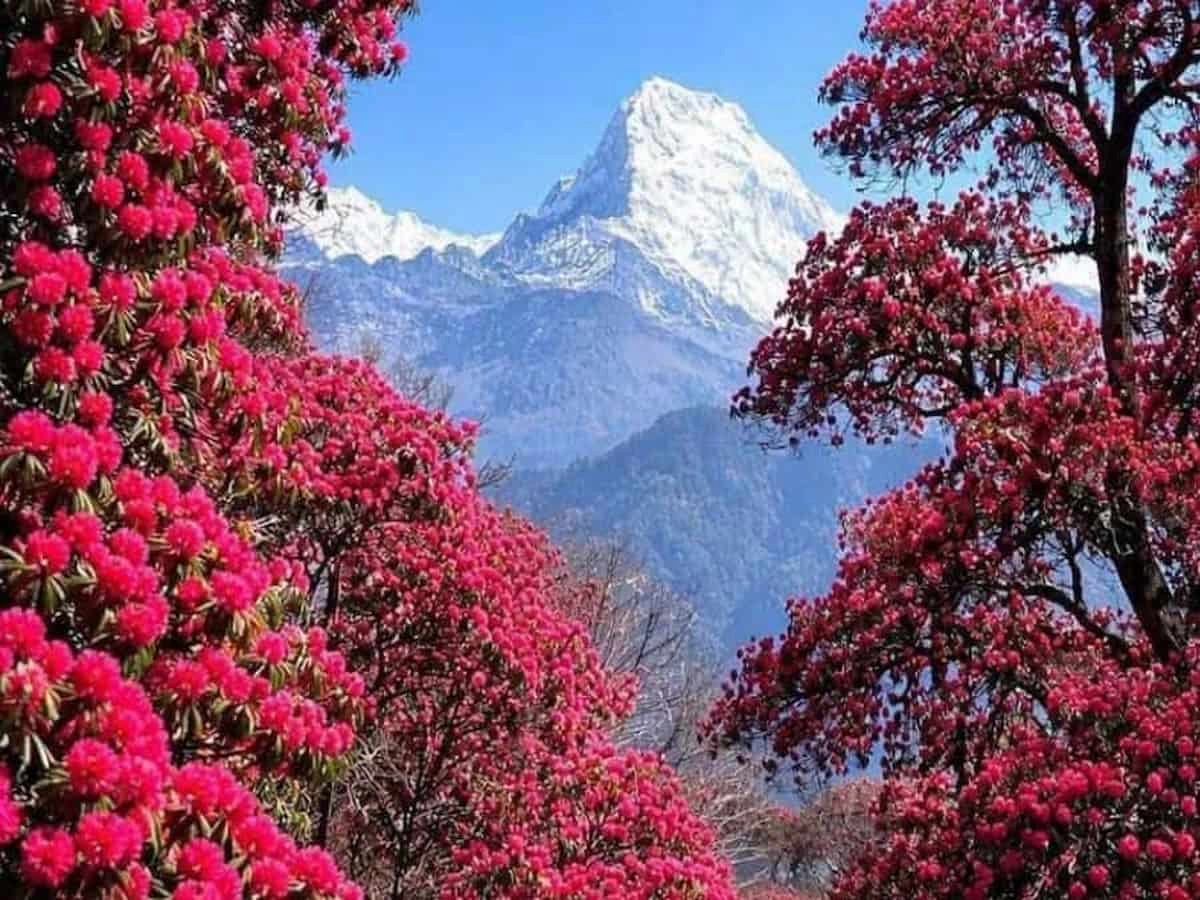
When you reach Ghorepani, you are at the edge of a forest of magnificent giant rhododendrons big enough to make you feel tiny, with the trail ahead invisible and arching trees above.
In spring, the rhododendrons bloom in many shades of pink and white. During the blooming season, walking through the rhododendron forest while trekking to Poon Hill in Nepal is one of the most unforgettable sights of Himalayan trekking. You cannot find such an unchanged trek in Nepal. The starting 1/2 of the trek ends up with the Poon Hill viewpoint. (3,210 m).
Per the signboard, located at your departure point for Ghorepani before dawn, drink your initial loser's coffee of daylight and trek for an hour by headlamp to reach the summit's wooden nesting tower on time as the sun rises.
The Annapurna Mountains come into view as dawn breaks out and to the northwest, Dhaulagiri the second highest of Himalayas (8,167m) and the Annapurna south (junchuli), to their right, Annapurna I, l to its right, and to the southeast the striking fishtail profile of Machhapuchhre here, A Great White Barrier to the southeast, and Datta Po to its right.
Poon Hill's Sunrise is one of the most photographed mountain views in all of Nepal, after the Everest region. And it truly stands up to its claim! The forest after Tadapani is mixed. As you descend the track toward the valley of the Modi Khola, traces weave their way along the bank, between dense bamboo woods, crossing suspension bridges over icy streams, and under the cool, damp, pine-scented atmosphere.
Waterfalls cascade steeply from both sides of the valley walls. At the approach to Deurali and MBC, the trees and foliage are receding at the edges, and the mountain tops seem increasingly near at hand. Annapurna, the real refuge is a wholly different matter.
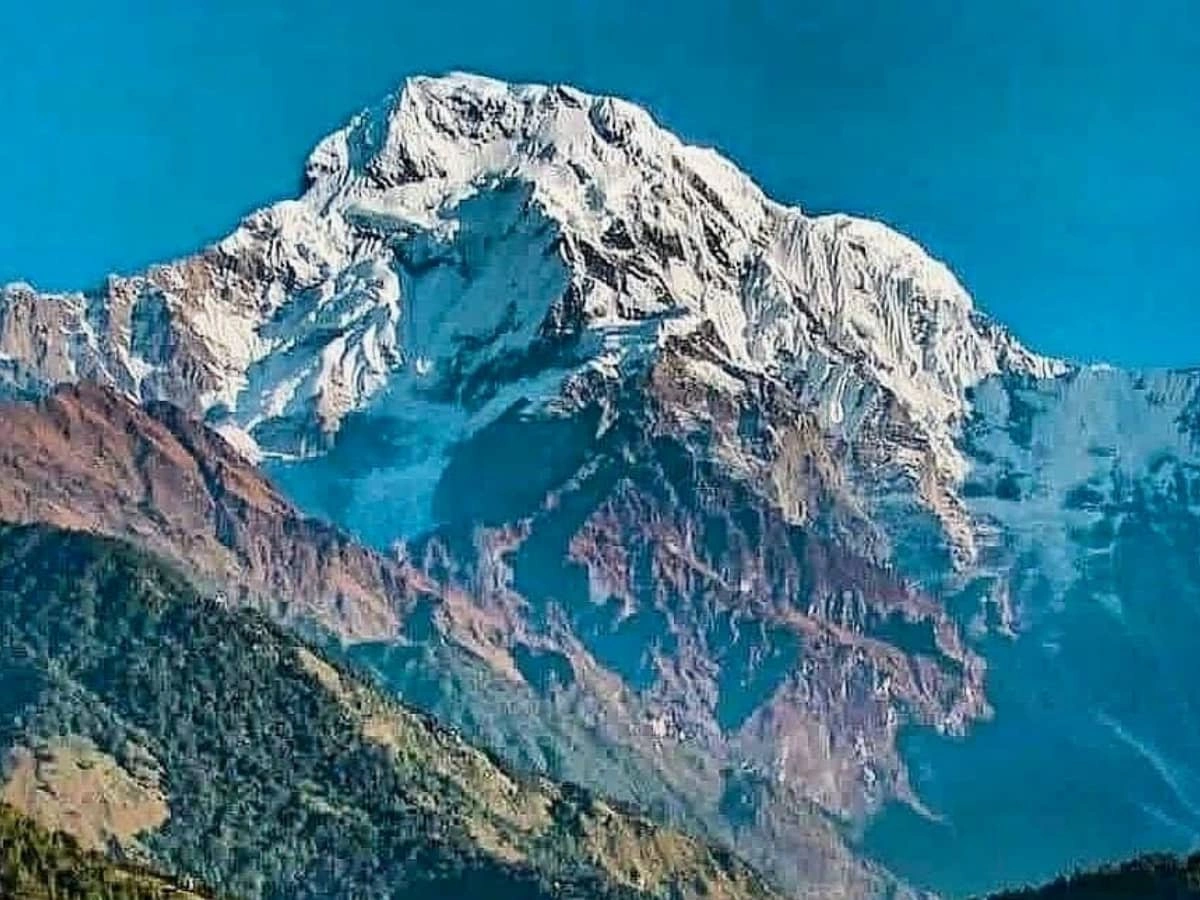
The sharp peaks of Annapurna I (8,091 m), Annapurna South, Hiunchuli, Gangapurna, and Machapuchhre have no subtleties about the scale. One tends to find most people walk into ABC for the first time and look around for a couple of minutes until they have enough guts to open their mouths.
Annapurna I (8,091 m): The tenth-highest mountain on Earth, visible from Poon Hill and dominant at ABC
Machhapuchhre (6,993 m): The "Fishtail Mountain," never climbed (sacred to the Gurungs), visible from almost the entire route
Annapurna South (7,219m): The most prominently visible summit from the Sanctuary floor
Hiunchuli (6,441 m): Guards the southern entrance to the Sanctuary
Dhaulagiri (8,167 m): The seventh-highest mountain on Earth, spectacular from Poon Hill
ABC Trek with Poon Hill: Distance and Elevation
Total trek distance of entire route (there and back as above): approximately 110 to 120 km (given trail selection). The Annapurna Base Camp trek's altitude gain is substantial. Starting out from Nayapul, at an altitude of 900 meters, and on to the ABC, at an altitude of 4130 meters. That is greater than 3,200 meters of altitude gain.
Acclimatization. It is very crucial. Fortunately, it is quite feasible considering the trail has fairly good linkage from Ghorepani to Tadapani. Ulleri 3000-stone step section: This is perhaps the most talked about section of the trek.
A punishing hill, the stairs from Birethanti to Ulleri are both steep and endless. No problem at this altitude (1960 m); it actually became one of the hardest descents of the trek. Go to Goa slowly and repeatedly, and stay hydrated, and you will be there in no time. 2 permits are required for this trek.
Both are compulsory, and they check for both existing throughout the route. TIMS Card (Trekkers' Information Management System) The TIMS card is 15 USD for group trekkers (through a registered trekking company)
1000 (free/individual trekkers). A sort of safety registration system that registers your existence on the route. To be obtained from the Nepal Tourism Board offices in Kathmandu (Bhrikuti Mandap) or in Pokhara (Damside). Holy Kailash Tours can process this for all clients doing the Annapurna Base Camp trek.
ACAP Permit (The Annapurna Conservation Area Project): To obtain the ACAP permit, you will need to pay USD 30 (or NPR 3,000 for Nepali citizens) for an individual permit. With a permit, you will have access to all trekking regions of the Annapurna Conservation Area, including Poon Hill and Annapurna Sanctuary.
The money from the ACAP permit is allocated to conservation and the maintenance of trails, and also to support the population of the area of wildlife protection.
You're responsible for bringing out both of the permits for the whole duration of the trek. At checkpoints in Birethanti, Chhomrong, and at the entrance to the Sanctuary, rangers will always require seeing them.
There is simply no way to get around this. They are not worth the fines or to be made to wait, and they are used to sustain the things you will be using on the trek.
Thanks to the Annapurna Base Camp Trek permits for tourists from other countries. Arranging for them is quite simple, as the trekking company will handle everything on your behalf. It doesn't take too much; you simply need to provide your passport photograph and your passport information.
ABC via Poon Hill vs ABC: Which Trek Is Right for You?
|
Feature
|
ABC via Poon Hill
|
Direct ABC Trek
|
|
Duration
|
8 days on trail
|
5 to 7 days
|
|
Key Highlights
|
Poon Hill sunrise, rhododendron forests, Gurung villages, Annapurna Sanctuary
|
Annapurna Sanctuary, mountain scenery, traditional villages
|
|
Acclimatization
|
Gradual, better for beginners
|
More rapid elevation gain
|
|
Maximum Altitude
|
4,130 meters
|
4,130 meters
|
|
Scenic Experience
|
More varied, with sunrise views, forests, villages, and mountain landscapes
|
More direct focus on the Annapurna Sanctuary
|
|
Cultural Experience
|
Strong, with Gurung and Magar villages and family-run teahouses
|
Strong village and local culture along the route
|
|
Best For
|
Travelers who want a more varied Himalayan experience
|
Trekkers with limited time who want to reach ABC directly
|
Why Choose the ABC via the Poon Hill Route?
There's only one argument to be made for taking this route: you get more for your money. The full, shorter direct ABC trek through Kimche takes about 7 days. It hits the same points but misses the Ghorepani route, the Poon Hill dawn, the rhododendron woods trek, and the Tadapani crossing. For three additional days on the trail, the via Poon Hill route via adds what many trekkers regard as the finest section of the entire journey.
One of the main reasons why people take this route is photography; the Poon Hill viewpoint brings a fantastic vantage point for a whole host of 8,000m peaks, mountain air free from pollution, (more or less) perfect morning light and the redgreen bounty of the rhododendron forest sections during March and April. For the avid photographer, this counts. This route trains your body more naturally as well.
Instead of ascending to ABC on a good slope, gaining a lot of elevation at once, then descending Tadapani and climbing once more, your body has time to get used to the altitude. This is true mainly if this is your first high-altitude trek. Honestly, a 10-day Annapurna Base Camp trek via Poon Hill isn't that bad for a short trek.
Though you can try to find a 5-day Annapurna Base Camp trek or a 6-day Annapurna Base Camp trek that gets you to ABC by a direct route, it is sure to be too rushed for almost all trekkers. By the time you're in the 7-day Annapurna Base Camp trek territory, it is, of course, possible, but not if you want to do the Poon Hill extension. 10 days is the optimal length.
The Best Time to Visit the ABC Trek via Poon Hill
Spring (March-May): As usual, this is the most sought-after season and very well deserved too. The rhododendrons are in blossom from early March to the end, transforming the forests near Ghorepani and Tadapani into something that seems far-fetched. The weather is usually fine, although on many days the clouds build up in the afternoon.
It is quite warm for trekking. It is just the perfect time to see the rhododendrons from March through early May.
Autumn (September- November). Warm and dry, autumn definitely ranks high. The monsoon in the mountains ends by late September, leaving the peaks crisp and white and clear against brilliant blue skies. October is the preferred trekking month of many experienced trekkers in Nepal.
Visibility is good, and the trails tend to dry out after the monsoon, and the mountain views from Poon Hill and ABC are at their best. November is fine, but it gets quite cold, very quickly above 3000 metres and at night.
Winter (December-February): Great to travel during winter Yet it can be more difficult. The snow line is above 2,500 meters starting from December onwards. Trekking to the Ghorepani and ABC area can be snow-covered and really cold (even at night!). Tourists are almost gone.For those who are fit and well equipped, solitude is fantastic; just don't overlook this season.
Monsoon (June through August): The monsoon can be a blow to most trekkers. The trails are slick, leeches are infested, below 2,500 m clouds tend to hide Himalayan scenery for days at a time, and parts of the countryside are prone to landslides.
The hardy few who do end up attempting the trail do so solely for the lush green scenery and near-empty pathways, which is not a venture most people should undertake. The best time to do the Annapurna Base Camp trek through the Poon Hill trek is in October for mountain viewing or late March through April for rhododendrons and ok weather.
Annapurna Base Camp Trek via Poon Hill Difficulty
This is a moderate to moderately strenuous trek. It's not technical, but it asks something real of your body over 10 days.The hardest single section is the stone staircase between Birethanti and Ulleri. The Ulleri 3000 stone-Step climb is steep, relentless, and happens on day one of the actual trekking when your legs aren't yet conditioned. It's famous enough that it comes up in almost every Annapurna Base Camp trek. Go slowly. The steps are also slippery when wet.
Above Chhomrong, the trail into the Annapurna Sanctuary steepens again, and altitude starts to take effect. The approach to MBC, and then to ABC, gains height quickly. Most fit, healthy adults handle it fine with proper pacing, but altitude affects everyone differently.
For first-time trekkers, this is a manageable route with a good guide. You don't need prior trekking experience in Nepal specifically, but arriving with a basic level of cardiovascular fitness makes a real difference. Walking 5 to 7 hours a day for 10 days is what this trek asks. If you walk regularly at home, that's a good starting baseline.
The Annapurna Base Camp trek reaches an altitude of 4,130 meters, below the threshold where altitude sickness becomes a serious concern for most people, but going too fast and not hydrating properly can still cause problems. The Annapurna Base Camp trek guide assigned by Holy Kailash Tours monitors trekkers for altitude symptoms throughout the journey.
Teahouse Accommodation and Food on the ABC Trek
Most of the trail running from Nayapul to Annapurna Base Camp is dotted with tea houses offering overnight stays to trekkers on route. The trail has no sections where camping is permitted; that means making the trek more manageable and cheaper, as one does not have to carry a tent on their back. Lodging
The tea house rooms offer minimum standards of a bed and a place to sleep. In the lower villages (e.g., Ulleri, Ghorepani, and Chhomrong), the permitted room is wooden with a single- or twin-bed, a thin mattress, a pillow, and a blanket. Many newer accommodation units are equipped with attached bathrooms; older units have shared washroom facilities.
There are virtually no places where you don't get a hot shower except, of course, when you have to pay an additional NPR 100 to 200 for it. Most of the tea houses (e. g. From Nayapul to Chhomrong) offer you Wi-Fi, but the coverage gets sparser as you climb above Chhomrong, and Internet connections become slower. In addition, you may have to pay a very small fee to recharge your phone or another device above Chhomrong.
To sum up, the Annapurna Base Camp trek has only rudimentary but perfectly suitable accommodations for your use; your tired legs will feel the beds as comfortable after a long day's walk. Dining
No matter where you are along the whole route, tea houses serving dal bhat are just the place to stop. This dish consists of lentil soup (dal) served with steamed rice, vegetable curry, and a very light bread (papad) often made of wheat or rice. The portions are generous and can even be added upon. High amount of calories. Just right for your hiking days. Also, many menus are offering:
Momos dumplings (mainly filled with vegetables or beef) Noodle soups and thukpa Fried rice and noodles Breakfast: pancakes and porridge Tasty vegetable curries and pasta served at stock tea houses Black tea, milk tea, ginger tea, and coffee are available even if instant is above Chhomrong
Taking the higher altitude into consideration, the costs of meals naturally go up. So, a food item like a meal, which costs NPR 350 in Ulleri, may go up to NPR 700 when you reach Annapurna Base Camp. This is normal, and a genuine breakdown of the costs would cover it.
Annapurna Base Camp + Poon Hill Trek Package
A package trekking to Annapurna Base Camp, including Holy Kailash Tours, will be made to all be it a trek arrangement. This takes away the work arrangements, and you can relax and concentrate on the trek.
Holy Kailash Tours has been arranging long-term treks in the Himalayan region from the Kathmandu base. They have full knowledge of the track, from the varying season skill levels of the track to the innumerable tea houses that serve the most exquisite foods. Airport pickup/drop-off.
Kathmandu flights provide pickup and drop-off at the airport. You can be picked up at the airport or dropped off at the airport directly from Kathmandu flights.
Accommodation: Hotel room in Kathmandu (2 nights before trek and 2 nights in Pokhara); hotels in Annapurna, Sikhowk, and Poon Hill; Private car transfer from Pokhara to the beginning of the trek and transport back to Pokhara. Meals in tea houses. Cheap accommodation on the trek. 3 courses of food (breakfast, lunch, and dinner) every day while on the trek.
Our trekking guide is experienced. Transported two trekkers (20 kg heavy). The permit involves transporting all in TIMS, ACAP, and None All Govt. Taxes shall be payable. Costs for Annapurna Base Camp trekkering are based on the group size and season for a 14-day trek.
The base cost for a private 10-day trek (without the air link and optional, additional goûts) is approximately USD 899–1199 per person. The average cost of a group trek in the Annapurna area is also less: USD 700,900 for a group size of 7-10 trekkers.
The Annapurna Base Camp trek cost for a Nepali citizen is much cheaper because they pay the local rate for the ACAP permit and TIMS. Questions about the exact pricing of the Annapurna Base Camp trek? For updated prices, please contact Holy Kailash Tours, and they will give you a straightforward list of exact prices without any hidden charges.
Annapurna Base Camp Trek Packing List
In reality, packing wisely is more significant than packing lightly, although preferably you will be able to do both.
Clothing (Layer System)
- Mainly the difference in layers. The temperature change between Pokhara at 800 meters and ABC at 4,130 meters is quite a huge leap. You should have:
- Shirts and shirts (top and bottom) that get rid of moisture
- Light mid-layer such as a fleece or down jacket to keep warm in evenings and mornings
- Dry-weather and wind-resistant jacket as an outer shell
- Hiking trousers (one light, one warm)
- Warm beanie, cap, and face warmer
- Waterproof gloves
- Trekking socks made from wool or synthetic fiber (at least 4-5 pairs)
- Reliable trekking shoes with ankle support (must have been broken in before the trek)
- Dormitory-style slippers/sandals for tea house evenings
TREKKING SUPPLIES
- 2 or 3 backpacks with a capacity of 4 liters
- Walking sticks (very important because they minimize knee stress, especially on downhill hiking)
- Headlamp with additional batteries (necessary for Poon Hill sunrise)
- Sleeping bag that is rated down to -10°C (liner may be bought at tea house)
- Goggles (specially at the high altitude where UV radiation is strong and up to UV 400 or higher)
- Flasks or a hydration system with water (total volume capacity is 2 liters)
- Water filter or purification tabs
FIRST AID AND PHARMACEUTICALS
- The personal first-aid kit should include blister treatment, analgesics, and medication against diarrhea.
- Medicine for altitude illness (Diamox consult your doctor before the trek)
- SPF sun cream at least 50+ and SPF lip balm
- Alcohol-based hand sanitizers and toilet paper
- Taken prescription medications
- Documentation Papers
- Passport (essential for permits)
- Insurance papers against trekking at a high altitude and with evacuation covered
- Emergency contacts plus insurance hotline in printed form
Electronics
- Camera or smartphone fully charged
- Charging gadget (must be an item above Chhomrong, where it comes at an additional fee)
- International plug adapter
Trip Highlights
- Poon Hill sunrise: Watch the dawn at 5:00 AM as Dhaulagiri and Annapurna shift from grey to gold.
- Annapurna Base Camp: A naturally built circular theatre of peaks at 4,130 m. The place is worth coming to after a hard 8-day hike!
- Rhododendron forest: Ghorepani to Tadapani in April and June: The rhododendrons are thick and bright, and the place is pretty much a haven for peace.
- Chhomrong village: The best place on the trail for tea, food, restaurants and good bakeries. Perfect if you have a rest day.
- Modi Khola Canyon: One of Nepal's most spectacular river valleys, mostly unknown except among trekkers.
- Machhapuchhre Base Camp: A place worthy of its name. With the Fishtail Mountain looming above, the color of the sky changes and the wind starts becoming chilly.
- Gurung Culture: Experience traditional stone-terraced mountain architecture and legendary local hospitality in villages like Chhomrong and Tadapani.
- Electronics & Charging: Bring a portable charger; teahouses above Chhomrong charge a small fee for power access
- Local culture: Tea house meals, prayer flags, and the Gurung people. You are welcomed in a genuine, warm way. An authentic place, not only the trail.