I was very happy when I reached Annapurna Base Camp. I thought I would. Every travel blog I'd read made it sound like the emotional peak of a lifetime, and maybe for some people it is. For me, it was quieter than that. I stood at 4,130 metres, surrounded by walls of ice and rock on every side, and I just felt still.
That stillness is what I keep coming back to when people ask what the Annapurna Base Camp trek is like.
The ABC trek is one of Nepal's most popular walks, and for good reason. It takes you deep into the Annapurna Sanctuary, a high glacial basin ringed by some of the world's most dramatic peaks. You pass through rhododendron forests, Gurung villages, and terraced farmland. You sleep in cosy teahouses, eat dal bhat twice a day, and wake up to mountain light that no photo quite captures. The whole thing is hard to explain until you've done it.
This is my trekking diary from the full experience, including what I spent, what I ate, what surprised me, and what I'd do differently. I've also added a full itinerary, altitude breakdown, and practical tips for anyone planning the Nepal Annapurna Base Camp treksoon.
Annapurna Base Camp Trek Overview
Annapurna Base Camp
The Annapurna Base Camp trekis a point-to-point walk into one of the most enclosed mountain basins in the Himalayas. You start near Pokhara, a city of about 400,000 people with a lake and good coffee, and you end up at 4,130 metres surrounded by eight peaks above 6,000 metres and the south face of Annapurna I, the tenth-highest mountain on earth. The transition between those two places takes about seven days on foot.
That's the simple version.
The fuller version is that the ABC trek covers roughly 110 kilometres round trip, gains about 3,280 metres of elevation from start to finish, and passes through genuinely varied landscape. You walk through subtropical forest in the lower sections, terraced farmland on the middle slopes, bamboo and rhododendron forest above that, and then open alpine terrain as you approach the sanctuary. The trail follows the Modi Khola river for much of its upper half, climbing alongside it into the glacial basin where the base camp sits.
Most people complete the trek in 7 to 10 days. The standard route goes through Ghandruk, Chomrong, Deurali, and Machhapuchhre Base Camp before reaching ABC trek. Some variations skip Ghandruk and cut a day, but the Ghandruk route is worth doing if you have time. The village is one of the most interesting stops on the entire trail.
The key numbers:
Starting point: Nayapul or Ghandruk (roughly 1.5 to 2 hours from Pokhara by road)
Ending point: Annapurna Base Camp, 4,130m
Total distance: approximately 110 to 115 km round trip
Duration: 7 to 10 days, depending on route and pace
Highest point: Annapurna Base Camp, 4,130m
Daily walking time: 4 to 7 hours
Difficulty: moderate
The trail is well-marked and well-traveled. Teahouses sit at every major stop, so you don't need to carry a tent or cooking equipment. You don't need technical skills or mountaineering experience. You do need to be fit, patient, and honest with yourself about how your body responds to altitude.
ABC Trek Experience: What It Actually Feels Like on the Trail
The Annapurna Base Camp trek starts in Pokhara, a lakeside city in western Nepal that most trekkers use as a base before heading into the hills. From Pokhara, you either drive or take a short taxi to Nayapul or Ghandruk, depending on your route, and then the walking begins.
Day one is a jolt. Your legs aren't ready for the stone steps. Nobody's legs are ever ready for the stone steps. The trail between villages in this region is paved with flat slabs carved into the hillside, and while they're excellent at preventing erosion, they're relentless on the knees on the way down. After an hour, I started looking at the porters around me, carrying loads that weighed more than I did, and stopped complaining.
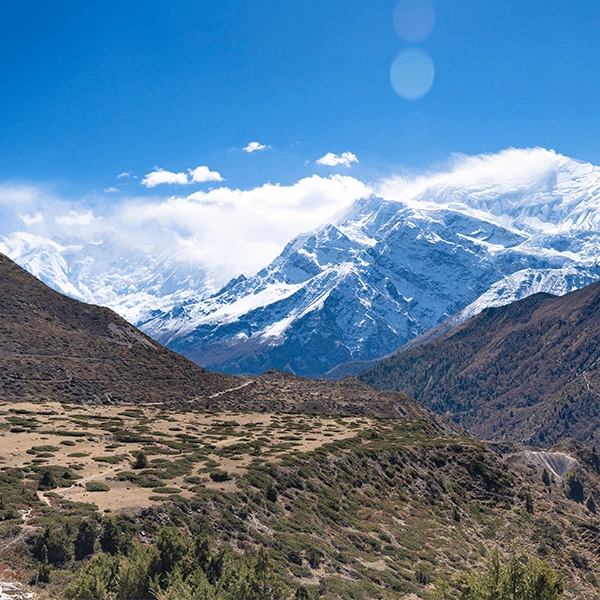
The Annapurna ABC trek unfolds gradually. You don't shoot up into thin air on day one. Instead, you gain elevation slowly over several days, passing through a series of villages that feel completely different from each other. Ghandruk is a large Gurung village with stone houses and a small but proper museum about local culture. Chomrong, higher up, is where you start to feel the altitude shift. Above Chomrong, the vegetation changes. The rhododendrons thin out. The air gets cooler. The path follows the Modi Khola river up into the sanctuary.
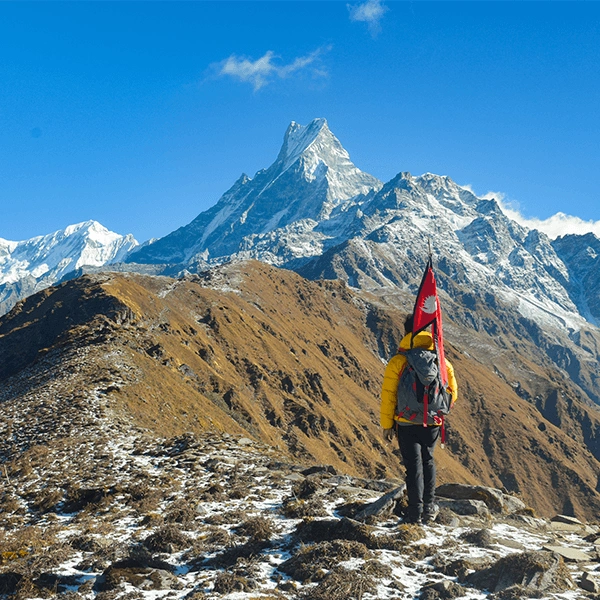
The moment you pass through the Annapurna Conservation Area checkpoint above Dovan, the mountains begin to appear. Machhapuchhre, the fish-tail peak that's actually off-limits to climbers, appears first. It's so vertical and so sharp, it looks unreal. Then Hiunchuli appears to the south, and eventually the great white wall of Annapurna I itself comes into view as you approach Machhapuchhre Base Camp (MBC) at 3,700 metres.
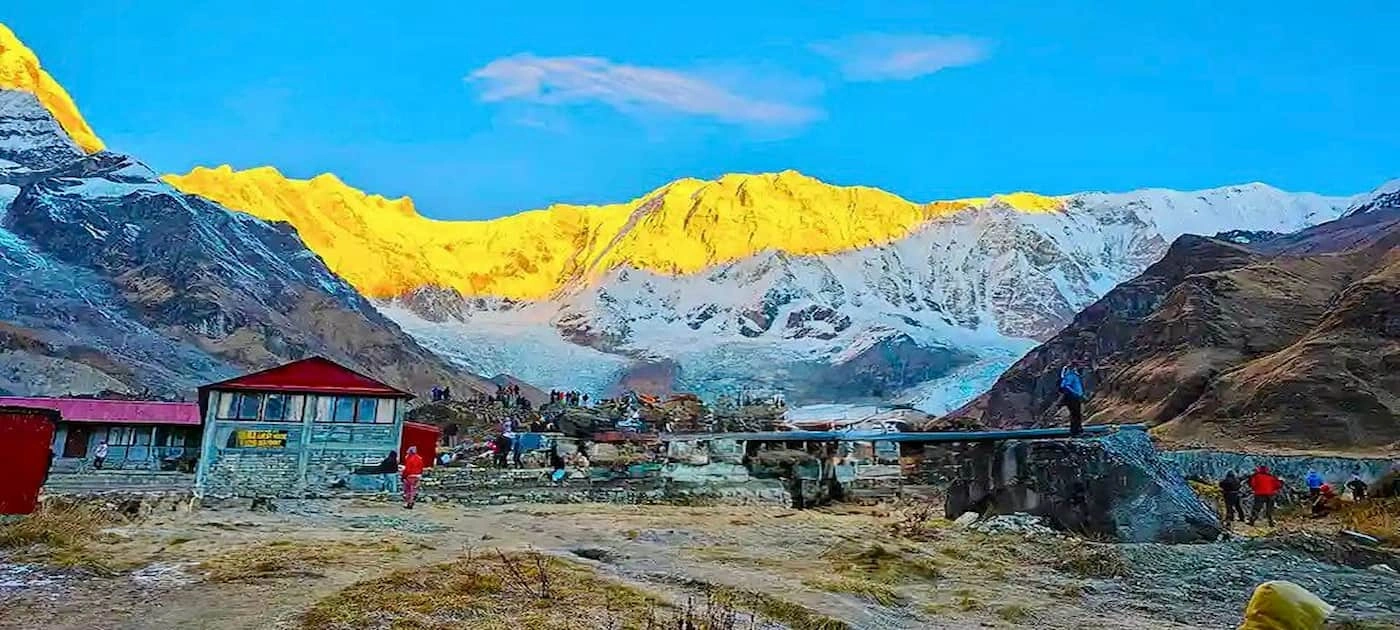
From MBC to Annapurna Base Camp is only about two to three hours of walking, but it's the stretch that stays with you. The trail runs across a glacial moraine and through boulder fields, and the mountains close in on every side. By the time you reach the ABC base camp, you're in a bowl of ice and rock that feels cut off from the rest of the world.
I stayed two nights at ABC because I wanted to watch the sunset and sunrise without rushing. Most people do one night. Two felt right to me.
Budget and Experience: Worth Every Penny
Annapurna base canp
People always want to know what the Annapurna Base Camp price comes to. The honest answer is that it varies a lot depending on how you travel. Here's a real breakdown.
Permits:
Annapurna Conservation Area Permit (ACAP): NPR 3,000 (roughly USD 22-23)
With a full agency package through an operator like Holy Kailash Tours: USD 1,000-1,500 depending on group size and inclusions
Is the ABC trek cost worth it? Without question. You get ten days of clean mountain air, extraordinary scenery, physical challenge, and cultural contact that you can't get from a resort or a city. I've spent more money on worse weekends.
Culture, Views, and Food: Three Things That Make This Trek
The Annapurna sanctuary trek itinerary takes you through some of Nepal's most culturally interesting landscapes. The Annapurna trekking route from Pokhara to Annapurna Base Camp passes through several ethnic communities with distinct traditions, and if you slow down enough to notice them, they make the trek far richer than just a walk to a glacier.
The trail from Pokhara to Annapurna base camp via Ghandruk takes you through the ancestral lands of the Gurung people, one of Nepal's most well-known mountain communities. Many Gurung men have historically served in Gurkha regiments, and that history shows in the villages: neat stone houses, well-maintained trails, and a certain quiet pride in the landscape.
Ghandruk Tramang Heritage site itself has a small Gurung museum worth an hour of your time. You can see traditional clothing, tools, and explanations of local customs. The women in Ghandruk often wear traditional black-and-red dresses and will happily pose for photos if you ask respectfully. A few of the older women speak no Nepali, only the local Gurung language, which gives you a sense of just how insular these mountain communities were until recently.
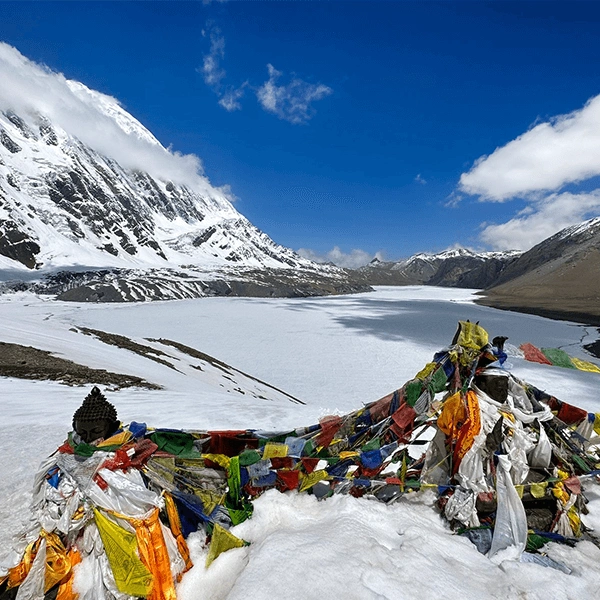
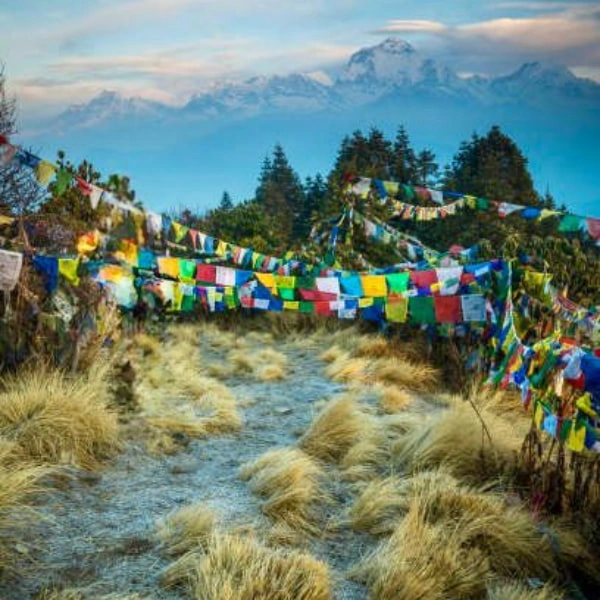
Higher up, in villages like Sinuwa and Chomrong, you also encounter Magar communities. The Magar people share mountain traditions but have distinct dialects and art forms. Prayer flags appear more frequently above Chomrong, strung between tea houses and across passes.
Culture: A Rich Tapestry of Tradition
ABC Trek
There are small Buddhist shrines scattered across the Annapurna Sanctuary trekking route. Some are old, their stones worn smooth. Others are clearly recent additions, with fresh paint and bright cloth. The monasteries in this region are not the grand gompas of Mustang or the Tibetan plateau, but they're active spaces, not tourist attractions, and that makes them feel more meaningful.
Festival timing matters if culture is a priority for you. The Gurung people celebrate Tamu Lhosar (their new year) in December or January, depending on the lunar calendar. If you happen to be on the Annapurna trekking route around that time, you'll see dancing, traditional dress, and music in the villages. It's worth planning around.
Where is Annapurna Base Camp exactly? It lies within the Annapurna Conservation Area, a protected area covering 7,629 square kilometres in western Nepal. The base camp itself is at the foot of the south face of Annapurna I (8,091m), inside the high glacial sanctuary. It's roughly 45 km northeast of Pokhara by trail.
The honest answer is that the Annapurna Circuit vs Base Camp debate is mostly a matter of time and style. The circuit is longer (two to three weeks), more remote, and crosses the high Thorong La pass. The base camp trek is shorter, more contained, and arguably more visually concentrated because you spend the final days inside the sanctuary walls.
If you're comparing Annapurna Base Camp vs. the Circuit in terms of scenery, both are extraordinary. The circuit gives you more variety and the crossing of the pass. The base camp trek gives you the sanctuary itself, which feels like being inside the mountains rather than just looking at them from the outside.
How does the Annapurna Circuit,Everest Base Camp comparison work? The Everest Base Camp trek has greater cultural prestige and the Khumbu glacier, but the ABC trek offers better views of the peaks around you during the final approach because the terrain is more enclosed. Both treks are doable for fit, motivated beginners.
The ABC trek wins on three things: accessibility from Pokhara, moderate difficulty compared to more technical routes, and the sheer concentration of scenery in a relatively short distance. You don't need mountaineering experience. You do need to be physically active and willing to walk for 6 to 8 hours a day.
Views: A Feast for the Eyes
ABC Trek
The views on this trek build slowly, which is the right way to take them in. You don't get the full picture all at once.
Ghandruk to Chomrong: The first real mountain views appear here. Annapurna South and Hiunchuli are visible from several points on this stretch of the Annapurna Base Camp route. The mornings are clearest. By noon, clouds often roll in from the south.
Chomrong to Deurali: You drop into the Modi Khola gorge and then climb back up through the forest. The trees are dense, and the views close in, but the sound of the river below is constant. Waterfalls appear on the cliff faces above you. Machhapuchhre starts to show itself in glimpses through the trees.
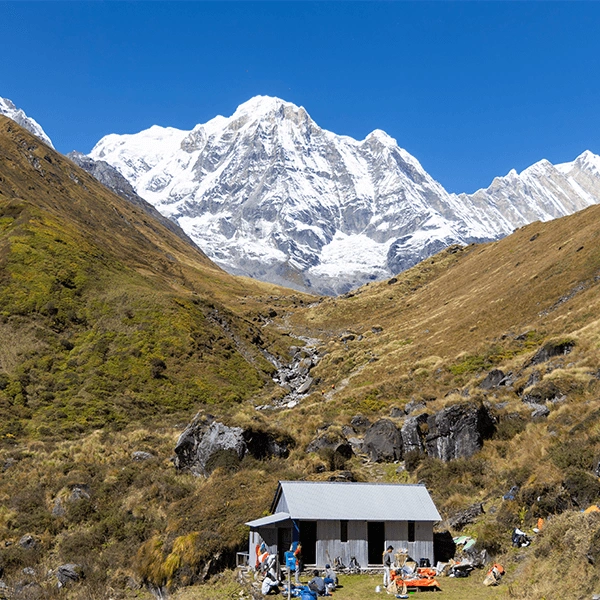
Machhapuchhre Base Camp: At 3,700 metres, the forest is gone, and the views open up completely. The fishtail shape of Machhapuchhre dominates the sky to the north. You can see Annapurna I and III, Hiunchuli, and Gangapurna. Most trekkers stop here for a meal or tea, and many catch the sunrise before the final push to ABC.
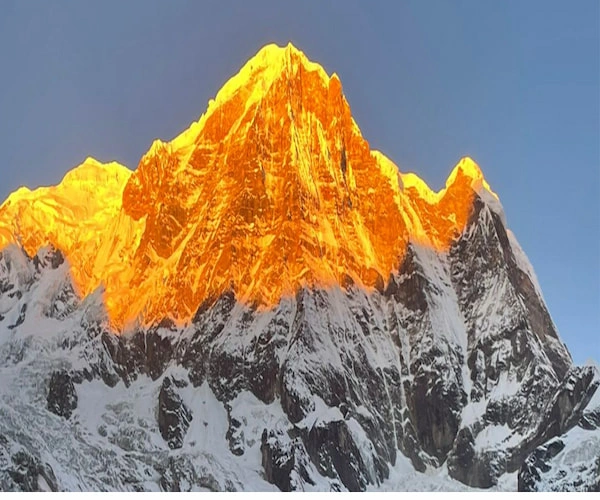
Annapurna Base Camp: The ABC trek route ends at 4,130 metres. From the camp, the view is a 360-degree circle of Himalayan rock and glacier. Annapurna I to the north, Annapurna South to the southeast, Gangapurna to the east, Machhapuchhre behind you. At sunrise, the peaks turn orange and pink before anything else does.
The Annapurna Base Camp trek distance from Nayapul to ABC and back is roughly 110-115 km round trip. The Annapurna Base Camp distance from Machhapuchhre Base Camp to ABC is only about 5 km, but it's slow going at altitude.
Teahouse food on the Annapurna Base Camp Trail is better than most people expect. The menus are long (sometimes comically so), but the actual options rotate around a core set of dishes, and that's fine because the core dishes are good.
Dal Bhat is the foundation of everything. It's a plate of steamed rice with lentil soup, vegetable curry, and pickles. Most teahouses offer free refills. It's filling, cheap (NPR 500-800), and genuinely satisfying after a long walking day. I ate it every night and sometimes at lunch too.
Noodle soups and pasta are popular at altitude because they're quick to make and easy on a stomach that's dealing with thin air. Garlic soup is worth ordering if you believe the folk wisdom that garlic helps with acclimatization (evidence is mixed, but it tastes good and doesn't hurt).
Breakfasts are typically eggs (boiled, scrambled, or omelette), porridge, toast, or pancakes with honey. Porridge with yak cheese is a personal recommendation if you see it on the menu.
Tea and coffee are available everywhere. Masala tea is excellent and cheap (NPR 80-150). Instant coffee is the norm, though a few better-stocked teahouses have filter coffee.
Budget for food: plan NPR 1,500-2,500 per day if you're eating three meals and a couple of snacks. Prices increase with altitude, which is standard across all Himalayan treks.
One note: above Deurali, food takes longer to prepare due to the altitude and limited fuel. Be patient. Eat regularly. Don't skip meals because you're tired.
Tips for Future Trekkers
EBC Trek
The Annapurna Base Camp trek is ofmoderate difficulty. It's not a technical climb; there are no ropes or crampons involved, but it's not a casual walk either. You're covering significant elevation over multiple days, so you need to be reasonably fit before you arrive.
Physical preparation:
Train with a loaded backpack for at least six to eight weeks before the trek
Stair climbing is the most specific preparation you can do
Cardio fitness matters more than strength here
Permits:
Get your ACAP and TIMS card in Pokhara or Kathmandu before the trek
You can do this at the Nepal Tourism Board office or through your trekking agency
Don't try to skip permits; checkpoints will stop you
On altitude:
The Annapurna Base Camp altitude is 4,130 metres
The Annapurna Base Camp elevation gain from Pokhara (850m) to ABC is about 3,280 metres over six to seven days
Go slowly. "Pole pole," as they say in Tanzania, but it applies everywhere at altitude
Symptoms of altitude sickness include headache, nausea, dizziness, and trouble sleeping
If symptoms worsen, descend immediately. No view is worth your health
Packing:
Waterproof boots (ankle support is important on uneven stone)
Trekking poles (your knees will thank you)
A good sleeping bag rated to at least -10C for ABC nights
Rain jacket (rain can happen any season in this region)
Sunscreen and sunglasses (UV is intense at altitude)
A small first aid kit with altitude sickness medication (Diamox) if your doctor has cleared you for it
How to go to Annapurna Base Camp:
Fly into Kathmandu, then take a domestic flight or bus to Pokhara (1-hour flight or 6-8 hours by bus)
From Pokhara, drive to the trailhead (Nayapul or Ghandruk)
A Heartfelt Thanks to the Team That Made It Possible
I wasn't trekking alone. I'd booked my trip through Holy Kailash Tours, a Kathmandu-based trekking and pilgrimage company I'd initially considered for a Kailash Mansarovar journey. When I mentioned I wanted to do the ABC trek first, they helped me plan that too.
My guide, Prem, was from Lamjung district, not far from the Annapurna region. He knew the trail the way you know your own neighborhood. He knew which teahouses had good kitchens, which sections of the trail got icy in the morning, and when to push and when to slow down. On day five, when I had a headache from the altitude, he didn't tell me it was fine. He told me to drink water, rest for an extra hour, and then see how I felt before deciding whether to continue. That kind of honest guidance is genuinely valuable at altitude.
My porter, Bikash, carried about 18 kilograms without complaint and arrived at every teahouse before me, which somehow never failed to surprise me. He always had my bag open and my sleeping bag ready before I'd even sat down.
Booking with Holy Kailash Tours meant I didn't have to figure out permits, teahouse bookings, or transport on my own. For a first-time trekker in Nepal, that matters. The team handled logistics cleanly and was reachable whenever I had questions before departure. If you're planning an ABC trek or any other Himalayan journey, they're worth contacting.
Annapurna Base Camp Elevation Gain: A Complete Guide
ABC Trek
Understanding the altitude profile of this trek is important for planning acclimatization and managing your energy.
Location
Elevation
Pokhara
850m
Nayapul
1,070m
Ghandruk
1,940m
Chomrong
2,170m
Sinuwa
2,360m
Bamboo
2,310m
Deurali
3,230m
Machhapuchhre Base Camp
3,700m
Annapurna Base Camp
4,130m
The Annapurna base camp elevation gain from the start of the trek to ABC is roughly 3,060 metres over about six trekking days. That's an average gain of around 500 metres per day, which is within safe acclimatization limits as long as you're not racing.
The most important section for acclimatization is the climb from Deurali (3,230m) to MBC (3,700m), then to ABC (4,130m). Most itineraries break this into two separate days, spending a night at MBC before pushing to ABC. That extra night at 3,700 metres makes a real difference.
Machhapuchhre Base Camp at 3,700 metres is where most altitude symptoms first appear. If you feel bad there, take an extra day. The difference between 3,700m and 4,130m is significant in terms of oxygen availability, and going up sick makes everything worse.
Altitude sickness prevention tips:
Hydrate consistently (3-4 litres of water per day)
Eat even when you're not hungry
Avoid alcohol for the first three days
Sleep lower than you trek if possible (the classic rule)
Don't ascend more than 500 metres per day above 3,000m
Annapurna Base Camp Trek Itinerary via Ghandruk Village
This is a classic 7-day Annapurna Base Camp itinerary. A shorter Annapurna Base Camp trek of 5 or 6 days is possible if you drive farther to the trailhead, but 7 days offers a safer acclimatization profile and more time to enjoy the trail.
Day
Route
Elevation
Walking Time
Day 1
Pokhara to Ghandruk
1,940m
5-6 hours
Day 2
Ghandruk to Chomrong
2,170m
4-5 hours
Day 3
Chomrong to Deurali
3,230m
6-7 hours
Day 4
Deurali to Machhapuchhre Base Camp
3,700m
3-4 hours
Day 5
MBC to Annapurna Base Camp and back to MBC
4,130m / 3,700m
5-6 hours
Day 6
MBC to Jhinu Danda (hot springs)
1,780m
5-6 hours
Day 7
Jhinu Danda to Pokhara
850m
4 hours walk + drive
Day 1: Pokhara to Ghandruk Drive from Pokhara to Nayapul (about 1.5 hours), then trek through Birethanti and up to Ghandruk. The first day is long but not technically hard. Ghandruk is a beautiful village with several good teahouses and a sweeping view of Annapurna South.
Day 2: Ghandruk to Chomrong. A relatively short day. The trail descends to the Modi Khola river and then climbs sharply to Chomrong. Chomrong is the last proper village before the sanctuary. Stock up on snacks here; prices rise above this point.
Day 3: Chomrong to Deurali A long day through bamboo forest, rhododendrons, and the deep Modi Khola gorge. You pass through Sinuwa and Bamboo (which is lower than Sinuwa, so there's a dip in the elevation profile) before climbing to Deurali.
Day 4: Deurali to Machhapuchhre Base Camp. A short but important day for acclimatization. The forest disappears, and the views explode open. MBC is a small cluster of teahouses with extraordinary views of Machhapuchhre and the first views of Annapurna I.
Day 5: MBC to ABC and back to MBC, the summit day. Leave early (6 am or before) for the best light and clearest skies. The trail to ABC crosses moraines and boulder fields. Spend two to three hours at ABC, watch the peaks, eat something warm, then descend back to MBC.
Day 6: MBC to Jhinu Danda. A long descent back through the forest. The hot springs at Jhinu Danda (a 20-minute walk from the village) are one of the best things about the whole trek. Your legs will appreciate them.
Day 7: Jhinu Danda to Pokhara. Walk back to the road at Siwai or Nayapul, then drive to Pokhara.
Shorter options:
Annapurna base camp trek 5 days: possible via jeep to Ghandruk on day one, skipping some intermediate stops. Not recommended for anyone without recent high-altitude experience.
Annapurna base camp trek 6 days: shave a day by driving further to the trailhead and doing longer days. Still manageable.
7-day Annapurna Base Camp trek: the standard, most comfortable option.
The Annapurna Base Camp route map is widely available at tourist offices in Pokhara and Kathmandu. Holy Kailash Tours also provides custom Annapurna Sanctuary trek itinerary options based on your fitness level and schedule.
Best Time to Trek Annapurna Base Camp
ABC Trek
The best season for the Annapurna Base Camp trek is either spring (March to May) or autumn (September to November). Both have their advantages.
Spring (March to May): This is my personal favourite. The rhododendrons are in bloom, painting the forests red and pink. The weather is generally stable, with clear mornings and some afternoon clouds. Annapurna Base Camp in April is particularly good because the rhododendrons are at their peak, and the winter snowpack is still clean and photogenic. As May gets warmer, pre-monsoon humidity builds.
Autumn (September to November): The most popular season. After the monsoon, the air is washed clean, and the mountain views are crisp. October is peak season, so teahouses fill up, and trails are busier. November gets cold, especially at altitude, but the skies are often the clearest of the year.
Winter (December to February): Annapurna base camp in December is cold, but possible. Teahouses above Chomrong may be closed or have reduced services. The trail can be icy and snow-covered above 3,000 metres. The reward is an almost empty trail and extraordinary clarity on clear days. If you're fit and well-equipped, a winter trek can be memorable.
Monsoon (June to August): Not recommended. The trail is slippery, leeches are out in force, and views are obscured by cloud. Some experienced trekkers do it for the challenge and lush greenery, but it's not the right choice for most people.
I left ABC feeling something I didn't expect: grateful. Not dramatically, not tearfully, just genuinely thankful for the chance to walk somewhere that still feels far from the noise of ordinary life.
The Annapurna Base Camp trek isn't the hardest thing you can do in Nepal. It isn't the longest. But it's one of the most complete. You get cultural depth, physical challenge, extraordinary scenery, good food, warm teahouses, and a goal worth reaching. All in a week.
If you're thinking about doing it, do it. Sort out your permits, book a good guide, and go.
If you want help with the logistics, I'd recommend reaching out to Holy Kailash Tours. They have genuine experience in Nepal's trekking and pilgrimage routes, and they handle the planning side well, which gives you more headspace to actually enjoy the mountains when you're out there. Whether you're planning the ABC trek, the Kailash Mansarovar Yatra, or another Himalayan journey, they're a reliable team to have on your side.
The mountains will still be there when you get to them. Make sure you are too.
1: How difficult is the Annapurna Base Camp trek for beginners?
The Annapurna Base Camp trek is rated moderate. It doesn't require technical skills or previous high-altitude experience, but you need to be physically active. The long walking days (5-7 hours) and stone staircases are demanding. If you can walk 10-15 km a day comfortably at home and have been doing some hill training, you'll be fine. Being overconfident is more dangerous than being underprepared here.
2: What is the best season for the ABC trek?
Spring (March to May) and autumn (September to November) are both excellent. October is the busiest and arguably the best for clear skies. April is the best time for rhododendron blooms. If you want fewer people on the trail, go in March or November. Avoid June to August unless you specifically want to experience the monsoon.
3: What is the total cost of the Annapurna Base Camp trek?
Budget trekkers can do it for USD 500-700, including permits, a guide, a porter, food, and accommodation for seven days. Mid-range travelers spending on comfortable teahouses and full agency packages should budget USD 1,000-1,500. The Annapurna Base Camp tour cost varies based on group size, level of support, and the number of days you add in Pokhara before and after.
4: Do I need a guide for the ABC trek?
Technically, no, since the trail is well-marked and other trekkers are usually around. But I'd strongly recommend hiring one, especially for a first visit to Nepal. A good guide adds safety at altitude, cultural context, and local knowledge that genuinely improve the experience. They also know which teahouses are worth staying in.
5: What altitude is Annapurna Base Camp?
Annapurna Base Camp sits at 4,130 metres (13,549 feet) above sea level. Machhapuchhre Base Camp, which you pass on the way, is at 3,700 metres. The Annapurna Base Camp elevation gain from Pokhara is roughly 3,280 metres, spread over six to seven days.
6: What permits do I need for the Annapurna Base Camp trek?
You need two permits: the Annapurna Conservation Area Permit (ACAP) and the TIMS card. Both are available in Pokhara and Kathmandu. The ACAP costs around NPR 3,000, and the TIMS card costs around NPR 2,000. Have them accessible because you'll pass multiple checkpoints on the trail.
7: Can I trek to Annapurna Base Camp in 5 days?
A 5-day Annapurna Base Camp trek is possible if you drive deep into the trailhead (up to Ghandruk) on day one. The Annapurna 5-day trek is better suited to people with recent high-altitude experience and who are not prone to altitude sickness. For most trekkers, 7-10 days is more comfortable and gives your body time to acclimatize properly.
Planning an ABC trek or another Nepal adventure? Holy Kailash Tours is based in Kathmandu and specializes in both trekking and pilgrimage journeys across the Himalayas.Contacttheir team for a custom itinerary.