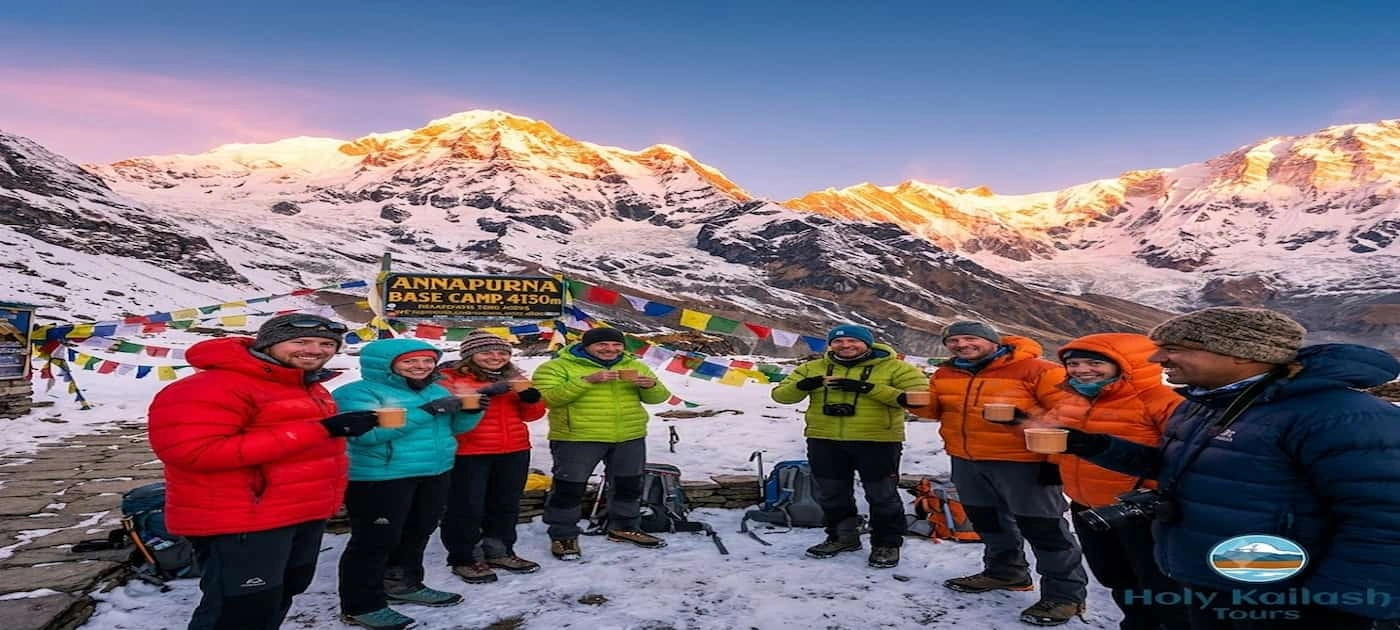
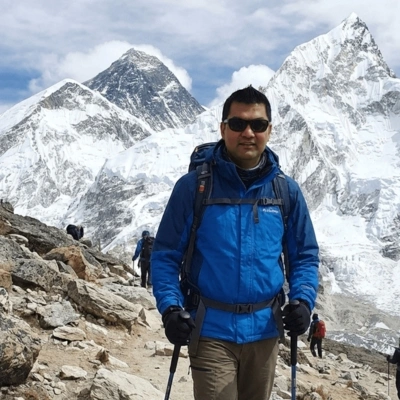
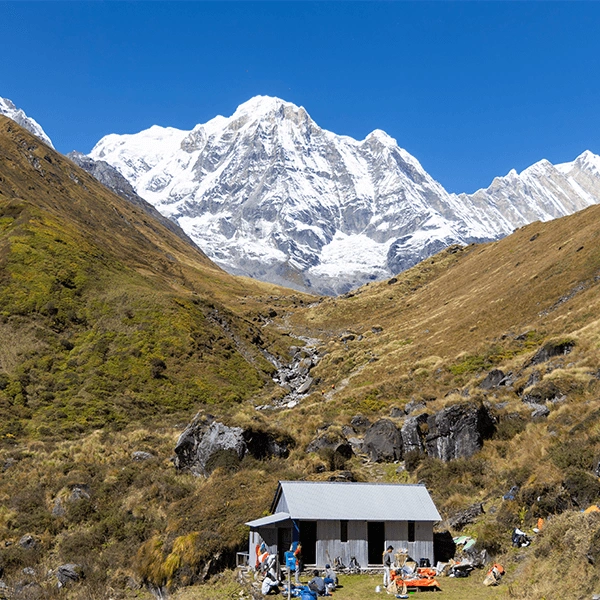
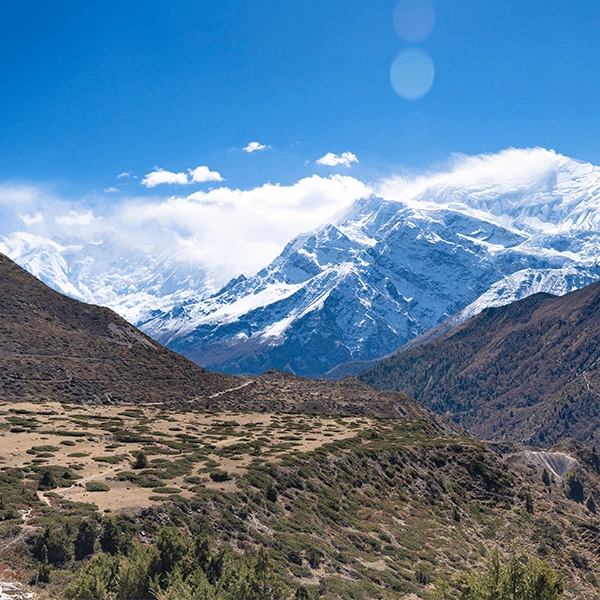
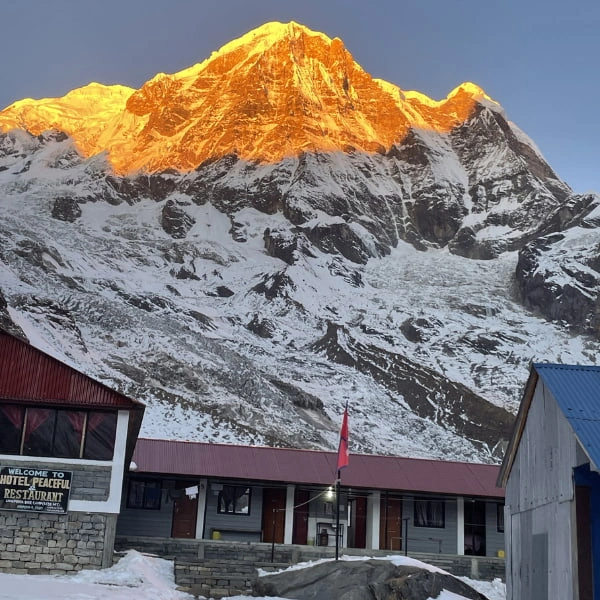
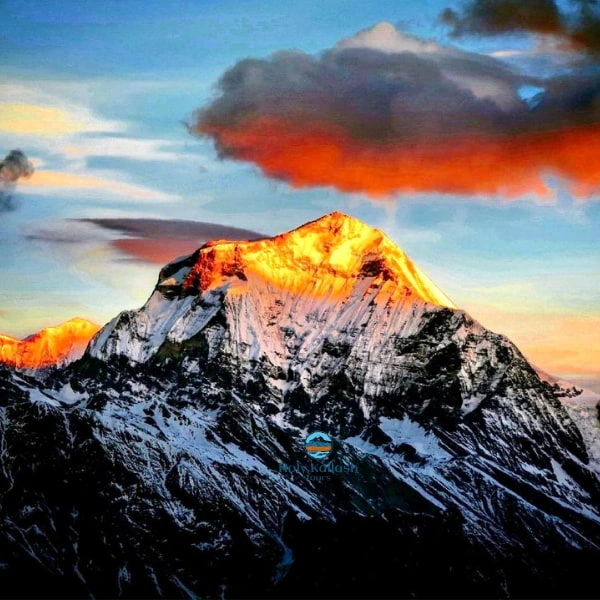
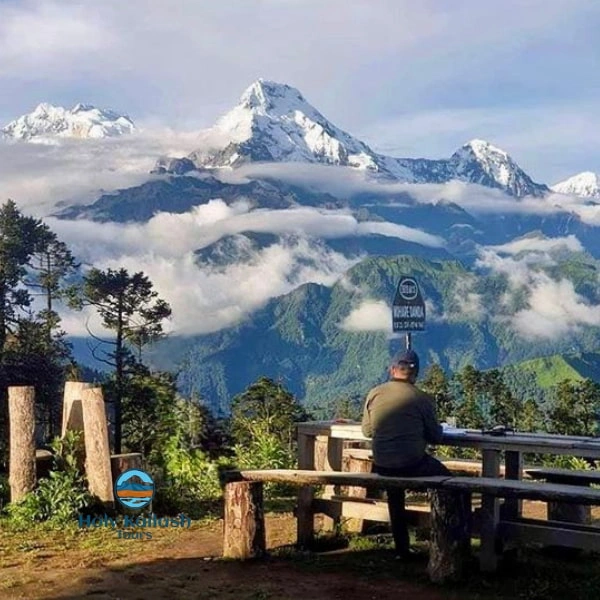
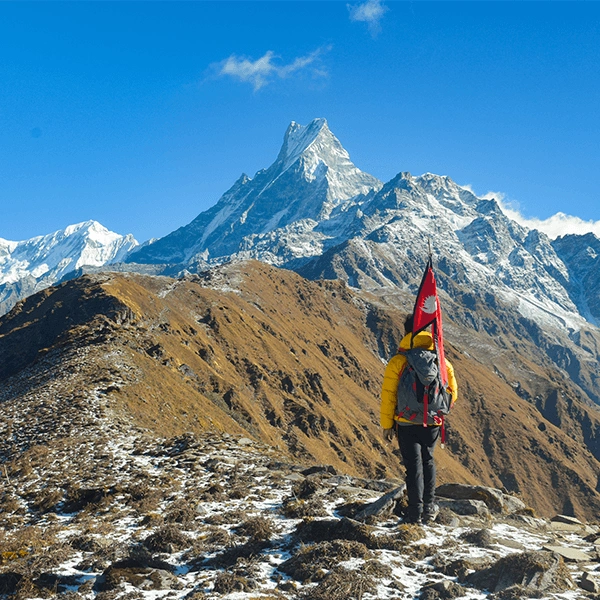
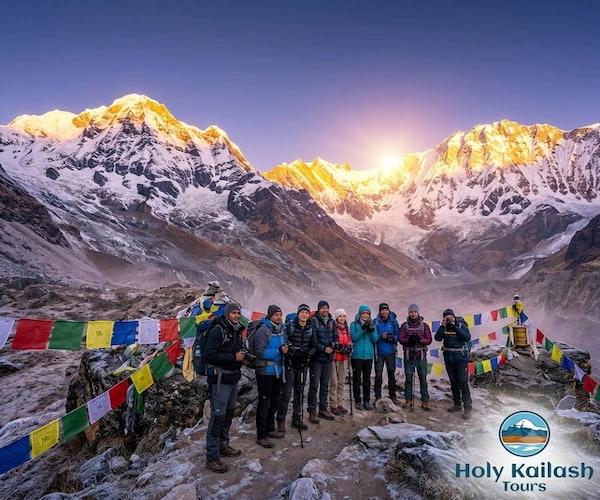
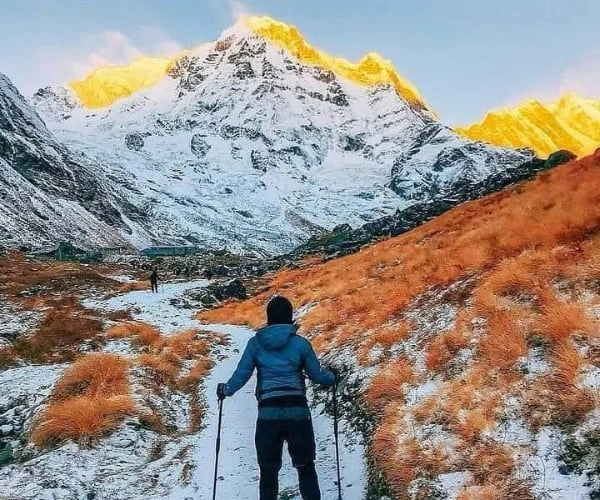
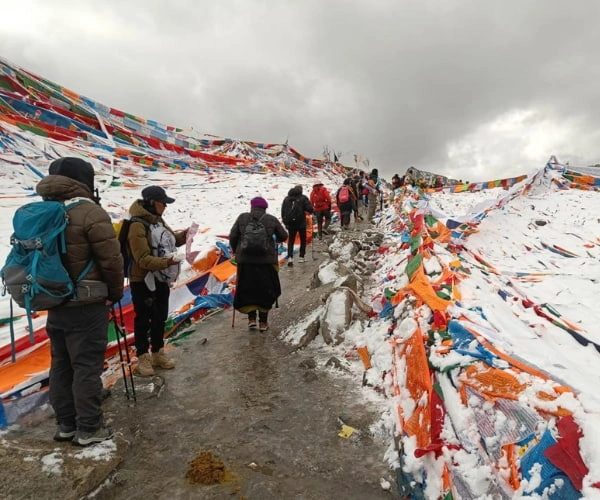
The Annapurna Base Camp trek, often shortened to the ABC trek, takes you into the Annapurna Sanctuary, a natural amphitheater of ice and rock sitting at about 4,130 meters. You're surrounded on almost every side by peaks over 7,000 meters, including Annapurna I, Annapurna South, Hiunchuli, and Machhapuchhre (Fishtail).
Unlike the longer Annapurna Circuit, this trek doesn't cross a high pass. You walk up a valley, through forest and farmland, and the mountains get closer and closer until you're standing in the middle of them. It usually takes 7 to 12 days, depending on your starting point, fitness, and how many rest days you build in.
What makes this trek different from Everest Base Campor other Himalayan routes is the variety packed into a short distance: rice terraces and subtropical forest, then rhododendron groves, then high alpine grassland, then glacial moraine, all in less than a week.
I still remember the first morning I woke up in Chhomrong, opened the guesthouse window, and saw Annapurna South sitting right there like it had been waiting for me. No fog, no clouds, just rock and snow against a flat blue sky. That's the moment most people talk about on this trek, and it's why I keep coming back.
Annapurna Base Camp Trek Trips Highlights
Caption
Every trip on this trail has its own rhythm, but certain things show up again and again.
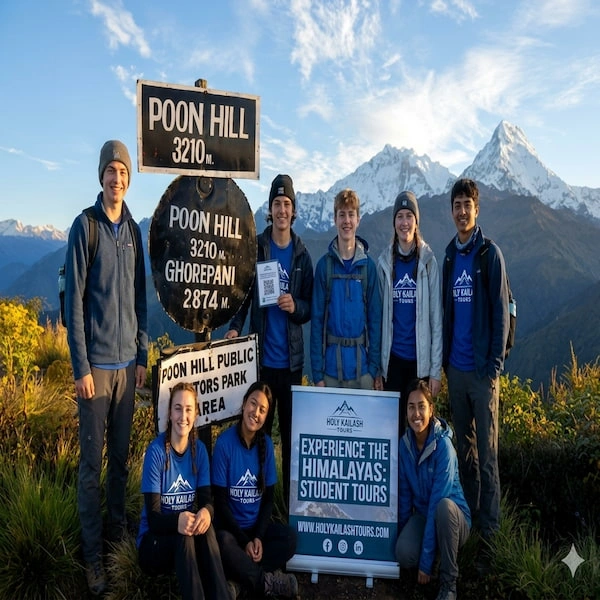
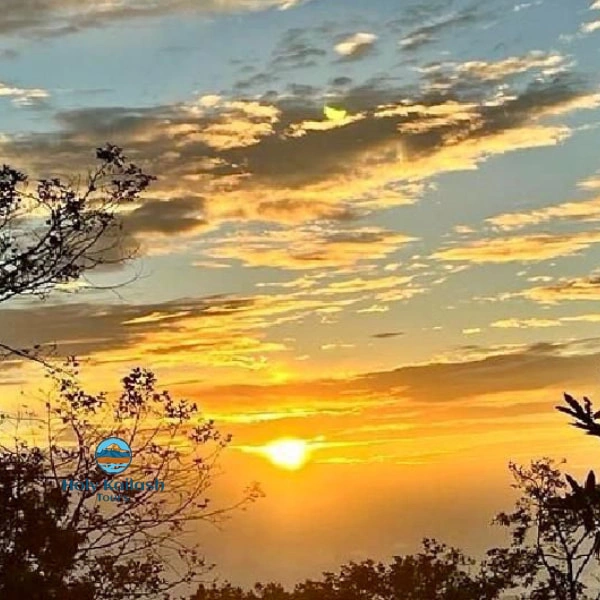
Sunrise views of Annapurna South and Machhapuchhre from Poon Hill or directly from Annapurna Base Camp
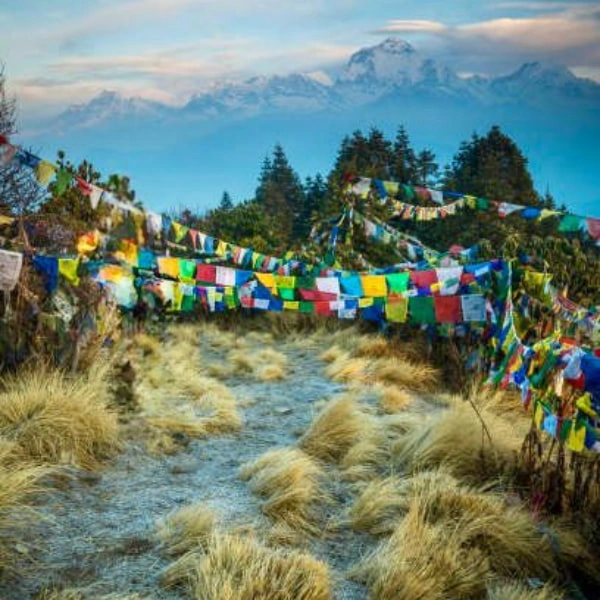
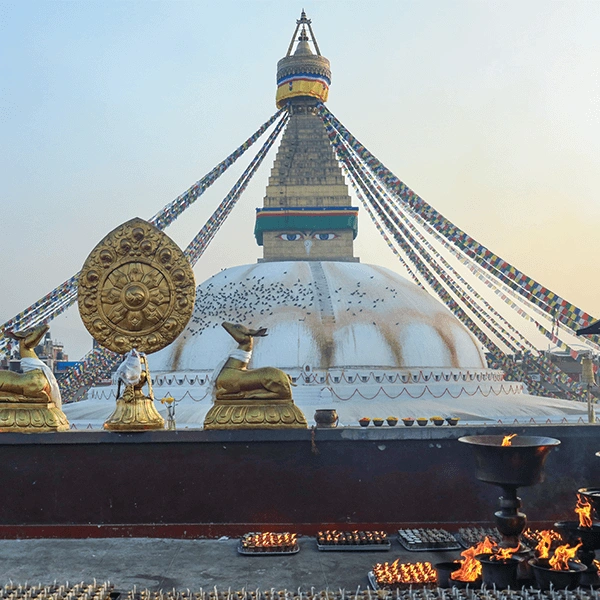
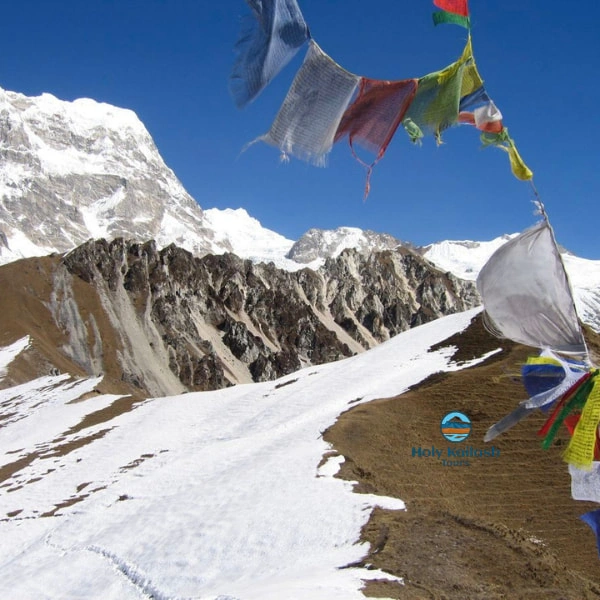
Walking through Gurung and Magar villages with stone houses and prayer flags strung between rooftops
Soaking in the natural hot springs at Jhinu Danda after a long day of descending
The dramatic narrowing of the valley near Hinku Cave, where cliffs rise straight up on both sides
Reaching the Sanctuary itself, where the temperature drops and the silence feels almost physical
Rhododendron forests in full bloom if you trek in spring, turning entire hillsides red and pink
Why the Annapurna Base Camp Trek Is One of Nepal's Best Treks
People ask why I recommend the ABC trek over other treks in Nepal, especially for first-timers. The honest answer is that it gives you the Himalaya without demanding weeks off work or a six-figure budget.
You don't need previous trekking experience, you don't need to acclimatize for a high pass, and you still end up inside a circle of 7,000-meter peaks. That combination is rare.
Shorter duration than most other Himalayan treks, usually 7 to 12 days
No technical climbing or high mountain pass to cross
Tea houses along the entire route, so no camping gear is required
Close-up mountain views that rival Everest Base Camp, often with fewer crowds on certain sections
Rich cultural mix of Gurung, Magar, and Brahmin communities along the way
Accessible from Pokhara, which is a short flight or drive from Kathmandu
That mix of accessibility and reward is why this trek stays booked year after year.
Where Is Annapurna Base Camp?
Caption
Annapurna Base Camp trek is within the Annapurna Conservation Area in north-central Nepal, in the Kaski district. It's part of what's called the Annapurna Sanctuary, a bowl-shaped basin ringed by some of the tallest peaks in the Annapurna massif.
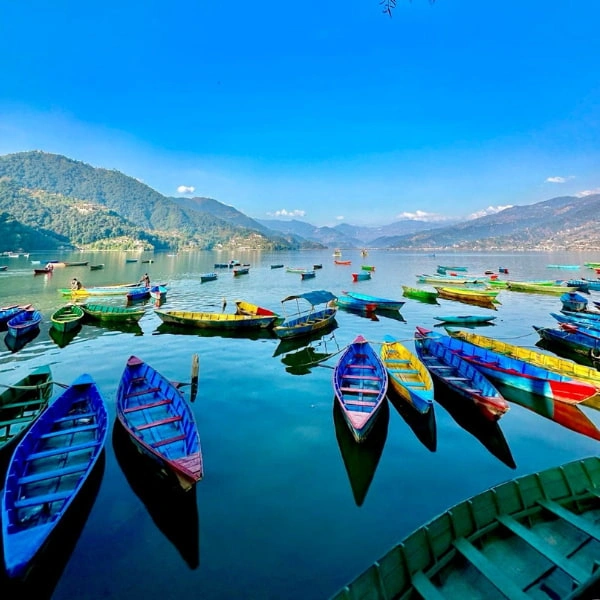
The trailhead is reached from Pokhara Valley, Nepal's second-largest city and the main hub for Annapurna region trekking. From Pokhara, you drive roughly two to three hours to a starting village such as Nayapul, Kimche, or Siwai, and the trekking begins from there.
The base camp itself stands at around 4,130 meters, well below the summit of Annapurna I at 8,091 meters, but high enough that you feel the air thin and the temperature drop fast once the sun goes behind the ridgeline.
The classic Annapurna trek route follows the Modi Khola river valley north from Pokhara into the Sanctuary. Most itineraries follow a similar shape, even if the start and end points shift slightly.
A typical route looks like this:
Pokhara to Nayapul (drive), then trek to Tikhedhunga or Tirkhedhunga
Tikhedhunga to Ghorepani, with a stop at Poon Hill for sunrise the next morning
Ghorepani to Tadapani through the rhododendron forest
Tadapani to Chhomrong, the last large village before the Sanctuary
Chhomrong to Bamboo or Dovan, descending into the Modi Khola gorge
Bamboo or Dovan to Himalaya or Deurali
Deurali to Machhapuchhre Base Camp (MBC)
MBC to Annapurna Base Camp (ABC), with most groups arriving by mid-morning
Descent back through Bamboo or Sinuwa, often via Jhinu Danda for the hot springs
Final descent to Nayapul or Siwai, then drive back to Pokhara
Some trekkers skip the Ghorepani Poon Hill trek and take a more direct route through Jhinu Danda. Either way works, and a good guide or operator like Holy Kailash Tours can adjust the route based on your fitness, time, and interests.
Day by Day Annapurna Base Camp Trek Itinerary
Caption
This is a standard 9- to 10-day Annapurna Base Camp trek itinerary that balances pace with adequate acclimatization. Adjust the number of days based on your schedule and energy.
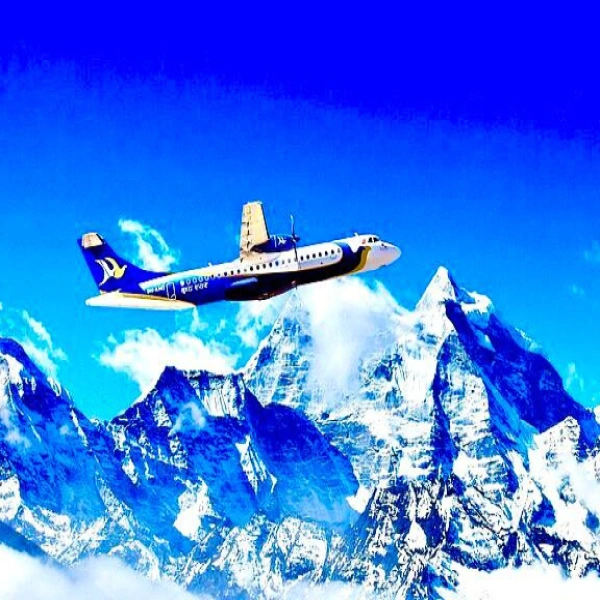
Day 1: Kathmandu to Pokhara. Fly or drive to Pokhara. Flights take about 25 minutes; the drive takes 6 to 7 hours. Most people use this day to rest and prepare gear.
Day 2: Pokhara to Nayapul, trek to Tikhedhunga. Drive about 1.5 hours to Nayapul, then walk 4 to 5 hours along the river valley to Tikhedhunga. Elevation gain is moderate, around 600 meters.
Day 3: Tikhedhunga to Ghorepani One of the toughest days on the trek, with a long uphill stretch through Ulleri's stone steps. Plan on 5 to 6 hours and an elevation gain of about 1,000 meters.
Day 4: Ghorepani, sunrise at Poon Hill, trek to Tadapani. Wake before dawn and climb about 45 minutes to Poon Hill for sunrise views of Dhaulagiri and the Annapurna range. Return for breakfast, then trek 5 to 6 hours to Tadapani through dense rhododendron forest.
Day 5: Tadapani to Chhomrong A shorter day, around 5 hours, with some steep descents and one significant climb into Chhomrong. This village is the gateway to the Sanctuary and has the last reliable shops and bakeries.
Day 6: Chhomrong to Bamboo Descend steeply from Chhomrong, cross the Chhomrong Khola, and walk along the gorge to Bamboo. About 5 to 6 hours, with bamboo forest closing in around the trail.
Day 7: Bamboo to Deurali (or Himalaya) A steady climb through forest that thins as you gain elevation. This is where the air starts feeling noticeably cooler. Roughly 5 to 6 hours.
Day 8: Deurali to Annapurna Base Camp, via Machhapuchhre Base Camp. The big day. You'll pass MBC at around 3,700 meters before continuing to ABC at 4,130 meters. Total walking time is 5 to 6 hours, often with snow underfoot in the final stretch.
Day 9: Annapurna Base Camp to Bamboo (or Sinuwa) Wake early for sunrise views from ABC, then begin the long descent. Most people walk all the way past MBC and Deurali to Bamboo or Sinuwa, around 6 to 7 hours.
Day 10: Bamboo to Jhinu Danda, hot springs, then to Siwai or Nayapul. Descend to Jhinu Danda and soak in the natural hot springs along the river before the final walk out and drive back to Pokhara.
Some itineraries compress this into 7 or 8 days for faster trekkers, while others stretch it to 12 days with extra rest stops. A flexible itinerary built around your pace usually beats a rigid one.
Timing matters more on this trek than people expect, mostly because of monsoon rain and winter snow at higher elevations.
Spring (March to May) Peak rhododendron season. Trails are colorful, temperatures are mild, and visibility is generally good in the mornings before afternoon haze builds.
Autumn (late September to November) Most guides, including the team at Holy Kailash Tours, consider this the best window. Skies are clear, and mountain views are sharp from sunrise to late afternoon.
Winter (December to February) Cold, with snow likely above 3,000 meters and possible trail closures near ABC after heavy snowfall. Doable for experienced trekkers with the right gear, but not ideal for beginners.
Monsoon (June to early September): Heavy rain, leeches in the lower forest, and frequent cloud cover blocking mountain views. Most operators discourage trekking in this period unless you want a quiet, green trail and don't mind getting wet.
If you want one piece of advice, book for October or November, then build in a buffer of one or two days in case of weather delays.
Annapurna Base Camp Trek Difficulty Level
Caption
This trek sits in the moderate category. It's harder than a day hike but easier than treks that cross high mountain passes like Thorong La on the Annapurna Circuit or Larkya La on the Manaslu Circuit.
The challenges stem from three factors: long daily walking hours, a mix of steep stone staircases (Ulleri alone has thousands of steps), and altitude gain over the final two days before ABC.
Daily walking time ranges from 4 to 7 hours
Total elevation gain from Nayapul to ABC is roughly 3,400 meters over several days
No technical climbing skills or equipment required
Reasonable fitness and a few months of preparation make this achievable for most healthy adults
Children, older trekkers, and casual hikers complete this trek every season, often with extra rest days
If you've done multi-day hiking before, even without mountain experience, you'll likely manage fine with proper pacing.
Altitude sickness can affect anyone above 2,500 meters, regardless of fitness level. The good news is that ABC's altitude profile is gentler than that of higher-elevation treks, which gives your body more time to adjust.
Walk slowly on uphill sections, slower than feels necessary
Drink at least 3 to 4 liters of water daily
Avoid alcohol and sleeping pills at altitude, since both interfere with your breathing and sleep quality
Eat enough carbohydrates, even if your appetite drops
Watch for headache, nausea, dizziness, or unusual fatigue, and report symptoms to your guide early
If symptoms worsen, descend rather than push through
Most ABC trekkers avoid serious altitude sickness since the trek tops out at 4,130 meters, but mild headaches and reduced appetite in the final two days are common and usually pass with rest and water.
Permits Required for the Annapurna Base Camp Trek
Caption
You need two permits for this trek, and both are straightforward to arrange in Kathmandu or Pokhara, or through your trekking operator before arrival.
Annapurna Conservation Area Permit (ACAP): Required since the trail passes through the Annapurna Conservation Area. Cost is around NPR 3,000 for foreign nationals.
TIMS Card (Trekkers' Information Management System): Used to track trekker movement for safety purposes. Cost is around NPR 2,000 for individual trekkers.
Both permits require a copy of the passport and passport photos. If you're trekking with an organized group through an operator like Holy Kailash Tours, the company typically handles the permit paperwork, saving you a trip to the permit office.
Costs vary depending on whether you go independently or with a guided package, and how much comfort you want along the way.
Independent trekking (per person, per day)
Teahouse: $5 to $10
Meals: $15 to $25
Permits (one time): $40 to $50 total
Porter or guide (optional): $20 to $30 per day
Guided trek package (full trip)
Budget operators: $750 to $800 for 9 to 10 days
Mid-range operators, including full-service companies like Holy Kailash Tours: $800 to $1,200
Premium packages with private transport and upgraded lodges: $1,200 and up
Extra costs to plan for include hot showers ($1 to $3 at higher elevations), device charging fees, Wi-Fi at some lodges, and tips for guides and porters, usually $10 to $15 per day for the full group.
Accommodation and Food on the Trek
Caption
ABC trek runs on the teahouse system, so you don't need to carry a tent or cooking gear. Lodges line the route, spaced close enough that you're never more than a few hours from the next one.
Rooms are simple: twin beds, a shared squat or sit toilet, and at higher elevations, no heating beyond a shared stove in the dining room. Hot showers are available at most stops, but cost extra above Chhomrong.
Food is hearty and carb-heavy, exactly what your body needs for the walking ahead.
Dal bhat (lentils, rice, vegetable curry) is the trekker staple, often with unlimited refills
Garlic soup is a local favorite, believed to help with altitude
Noodles, fried rice, and momos appear on most menus
Pancakes, porridge, and eggs cover breakfast
Apple pie and ginger tea are common treats at higher lodges, especially around Chhomrong
Prices rise with elevation since everything is carried up by porter or mule. A plate of dal bhat that costs $4 in Pokhara might cost $8 near ABC.
You don't need to be an athlete for The Annapuran Base Camp trek, but a few months of preparation make a real difference in how much you enjoy it versus how much you just survive it.
Start cardio training 2 to 3 months before departure: hiking, running, or stair climbing
Practice walking with a daypack to get used to carrying weight
Build leg strength with squats, lunges, and step-ups
Break in your hiking boots well before the trip, never on day one
If possible, do at least one multi-day hike beforehand to test your gear and stamina
Trekkers who arrive undertrained usually still finish, but they do so exhausted rather than energized, which changes how the whole trip feels.
The Annapurna Sanctuary trek packs unusual ecological variety into a short distance, since you climb from subtropical lowland to alpine terrain in less than a week.
Lower elevations show terraced rice paddies, banana trees, and bamboo groves
Mid elevations bring oak and rhododendron forest, with rhododendrons blooming red, pink, and white from March to April
Higher up, the forest gives way to scrub juniper and open grassland before turning to rock and snow near ABC
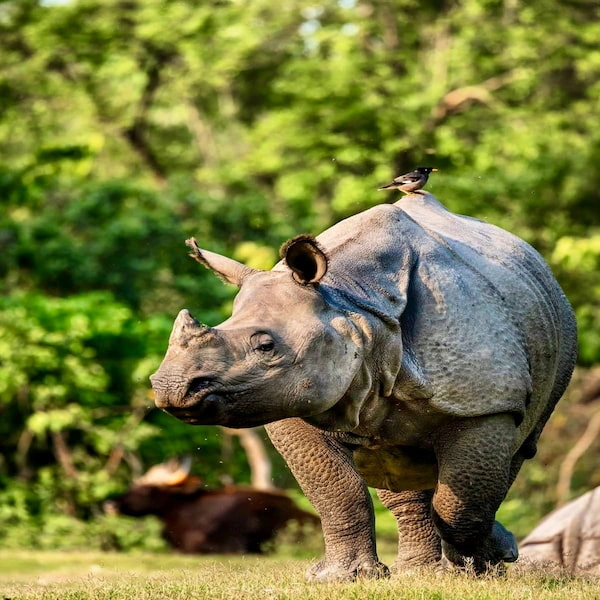
Wildlife sightings can include Himalayan langurs, musk deer, and various pheasant species, though sightings aren't guaranteed
Birdlife is active throughout, especially in the forested midsections
The landscape shift becomes part of the story. You notice the air thinning, the trees thinning, and eventually the silence thickening as you near the Sanctuary.
Most villages along this route belong to the Gurung community, known across Nepal for serving in Gurkha regiments and for strong mountain traditions.
Stone houses with slate roofs, prayer flags, and small village monasteries appear throughout Ghandruk, Chhomrong, and Landruk. Many lodges are family-run, often for generations, and the people working them know this trail better than any map ever could.
Ghandruk is one of the largest and most well-preserved Gurung villages on the route, worth a slower visit if your schedule allows
Local festivals, when timed right, sometimes coincide with trekking season and offer a glimpse into community life
Mani walls and chortens (Buddhist shrines) appear at village entrances, a small sign of the cultural blend in this region
Conversations with lodge owners often reveal more about the mountains than any guidebook
Spending an evening talking with a lodge family, rather than just passing through, tends to be the part people remember just as much as the mountain views.
This question comes up constantly, and the honest answer depends on experience and comfort with logistics, not just budget.
Solo trekking pros
More flexibility on pace and schedule
Lower cost since you skip the guide and porter fees
A sense of independence that some trekkers genuinely want
Solo trekking cons
You handle all permits, navigation, and lodge bookings yourself
Fewer safety nets if something goes wrong, especially during illness or injury
No local insight into culture, weather patterns, or trail conditions
Guided trekking pros
A guide manages permits, route decisions, and lodge arrangements
Built-in safety support and altitude monitoring
Local cultural context that adds depth to the trip
Porters carry your heavy gear, letting you walk lighter and faster
Guided trekking cons
Higher overall cost
Less flexibility on pace if traveling with a group
For first-time trekkers in Nepal, a guided trek through an established operator removes most of the stress. For experienced trekkers comfortable with logistics, solo trekking on this route is manageable since teahouses and trail markers are frequent.
Holy Kailash Tours is a Kathmandu-based travel operator that organizes treks and pilgrimages across Nepal and Tibet, including the Annapurna Base Camp trek, the Everest Base Camp trek, and the Kailash Mansarovar Yatra. The company is widely known for sacred journeys to Mount Kailash and Lake Mansarovar, but it also runs full Himalayan trekking packages for travelers who want mountain scenery without the pilgrimage focus.
For the Annapurna Base Camp trek, Holy Kailash Tours typically handles permits, accommodation bookings, experienced guides familiar with the route's altitude profile, and porter arrangements. Itineraries are adjusted based on trekker fitness, available time, and season, rather than being forced into a single fixed template.
What stands out about a Nepal-based operator on this trek is the local knowledge that's hard to get from an overseas booking platform: which lodges have the best stoves in the cold months, which sections flood first in the early monsoon, and how to pace trekkers arriving straight from sea level. If you want a Nepal-based team handling the details, Holy Kailash Tours is one option worth researching alongside other established operators.
Final Thoughts on the Ultimate Annapurna Base Camp Trek Guide
The Annapurna Base Camp trek rewards you fast. Within a week, you go from rice terraces to standing inside a ring of 7,000 and 8,000 meter peaks, without needing technical climbing skills or months of vacation time.
What stays with most trekkers isn't just the summit moment at ABC, but the small things along the way: garlic soup in a cold dining room, a Gurung grandmother explaining her family's history over tea, the river through the gorge near Bamboo. The mountains are the headline, but the trail fills in everything else.
Whether you go independently or with an operator, the trek delivers what it promises. Respect the altitude, pace yourself, and give the trail the time it deserves.
Frequently Asked Questions About the Annapurna Base Camp Trek
1. How many days does the Annapurna Base Camp trek take?
Most itineraries run 7 to 12 days. A 9 to 10-day plan is the most common.
2. How difficult is the Annapurna Base Camp trek?
It's rated moderate. Long walking days and steep stone staircases make it demanding, but no technical climbing skills are required.
3. What is the elevation of Annapurna Base Camp?
About 4,130 meters above sea level.
4. What permits do I need for the Annapurna Base Camp trek?
The Annapurna Conservation Area Permit (ACAP) and a TIMS card, both arranged in Kathmandu, Pokhara, or through your trekking operator.
5. When is the best time to trek to Annapurna Base Camp?
Autumn (late September to November) and spring (March to May) offer the clearest skies and most stable weather.
6. Can a beginner do the Annapurna Base Camp trek?
Yes. With a few months of fitness preparation, many first-time trekkers complete this route, often taking extra rest days to pace.
7. How much does the Annapurna Base Camp trek cost?
Independent trekking can run $500 to $700 total for permits, food, and lodging, while guided packages typically cost $700 to $1,200.
8. Do I need a guide for the Annapurna Base Camp trek?
Not legally, but a guide adds safety, local insight, and logistical convenience, especially for first-time visitors to Nepal.
9. Is altitude sickness a risk on this trek?
Mild symptoms like headache or reduced appetite are common above 3,000 meters, but serious altitude sickness is less likely than on treks above 5,000 meters, since ABC tops out at 4,130 meters.
10. What should I pack for the Annapurna Base Camp trek?
Layered clothing, a warm sleeping bag, broken-in hiking boots, a headlamp, and basic first aid supplies cover most needs. See the full packing list earlier in this guide.
11. Are there ATMs along the Annapurna Base Camp trek route?
No. Withdraw cash in Pokhara before starting.
12. Is the Annapurna Base Camp trek suitable for children or older trekkers?
Yes, with proper pacing and extra rest days. Families and older trekkers complete this route every season.
13. What kind of accommodation is available on the trek?
Teahouses line the entire route, offering basic twin rooms, shared bathrooms, and dining halls serving local and trekker-friendly food.
14. How do I get to the start of the Annapurna Base Camp trek?
Fly or drive from Kathmandu to Pokhara, then take a short drive to a trailhead village such as Nayapul.
15. Can I trek to Annapurna Base Camp during the monsoon season?
It's possible, but not recommended, due to heavy rain, leeches in the lower forest sections, and frequent cloud cover that blocks mountain views.